
English Version
Deutsche Version
In English Language
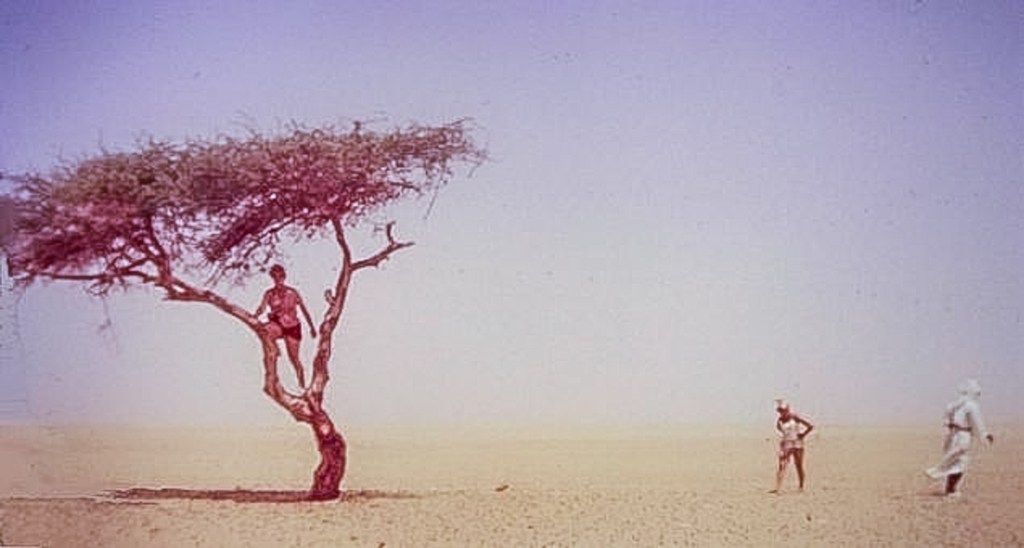
The loneliest tree of all time was probably the Arbre du Ténéré, an umbrella acacia of the species Acacia raddiana or Acacia tortilus, in the middle of the Ténéré desert in Niger. According to reports, no other tree, either of its own or of any other species, existed within 400 kilometers. Just desert, sand, no green. “You have to see the tree to believe its existence,” wrote the French officer Michel Lesourd, who was stationed in what was then French West Africa in 1938/39, in May 1939. “How can it […] remain undestructed?”
Apparently the tree, which must have once belonged to a forest or at least a group of trees, was the only one that over time managed to develop roots to a depth of 36 meters and thus maintain contact with the groundwater table. For decades. This was shown by an excavation near the tree in the winter of 1938/39.
The hermitage was used by caravans in the area as a landmark on their routes through northeastern Niger.
A truck driver is said to have cut down this tree to make firewood. On November 8, 1973, about 50 years ago, the remains were brought to the National Museum of Niger in Niamey. A tree-like metal sculpture now stands in the desert in memory of the acacia tree.
400 kilometers of solitude
This distance is really huge and the death of the tree is really sad. All people think; “Ohh, the poor tree, 400 km lonely and the drunk truck driver. No respect.“
No, dear friends, there is something much sadder. Us.
It is we who should be sad about ourselves, because we are much lonelier than the Arbre du Ténéré.
We have to keep reminding ourselves of this: we won’t exist again. The earth is alone. There is no other life for miles around. We are the tree.
We imagine, I hope, there is other life in space. That would be wonderful. I am firmly convinced that there is life in the solar system of our nearest star. Like us.
This could perhaps be at Proxima Centauri, our first neighboring star. Proxima Centauri, also called V645 Centauri or Alpha Centauri C, is the closest star to the Sun at a distance of about 4,247 light years.
14.91 Stone Ages
Life in the neighboring star’s solar system. That would be wonderful. We would definitely like to visit them sometime.
I’ll give you a few numbers:
The distance to Proxima Centauri (PC) is 4,247 light years.
1 light year is 9,460,730,472,581 km.
The distance to PC is therefore:
40,179,722,317,051 km.
The sound is 1 Mach = 343 meters per second
If you shout very loudly, your sound will reach 10,824,256.80 km per year. Even louder…
So you have to wait 3,712,007 years for your reputation to reach PC.
The Voyager 1 spacecraft flies at 61,500 km/hour. That’s 539,109,000 km per year.
To PC, Voyager 1 has been traveling for 74,529 years. If humans travel in a rocket and have a new generation of children every 30 years, then it will be 2,484 generations until the rocket lands on Proxima.
Or to put it another way: Since the Stone Age 5,000 years ago, humanity has developed once until today. In the rocket to Proxima Centauri, the astronauts must repeat humanity’s evolution 14.91 times until they arrive.
The Arbre du Ténéré was lonely at a distance of 400 kilometers. We now call this distance 1 AT, as a measurement with a length of 1 millimeter and measure the distance to PC in AT. The length is 100,499.306 AT. We are over 100 thousand kilometers further away than 1 AT in millimeters, or 2.5 times around the Earth for 1 millimeter AT.
So when it comes to loneliness, it’s us. We humans and animals and plants, insects and bacteria. All. We all. We are the loneliest creatures.
And what do we do? We argue. We rob and murder. We enrich ourselves and let the poor starve. We eat the animals and clear the forests. We are gassing the environment and we are poisoning the water we drink from.
Human intelligence is at the zero point of intelligence. Zero point zero intelligence.
So if we are sad about the Arbre du Ténéré, how much sadder should we be about ourselves? How much more intelligence should we use to protect ourselves? Not just ourselves, but the environment, life, our fellow residents?
It’s not going to happen.
People will not be able to protect their environment so that it does not experience the fate of the lonely tree.
Unfortunately.
Nobody will notice this. Nobody will cry, nobody will conduct archaeological excavations over us.
If we don’t change our entire system of life and our way of thinking soon, we will no longer exist and no one will be sad about it. The earth will devastate and become a stone planet. Every now and then Etna will spit and that’s it.
Maybe in 4 million years a spaceship will come by and land on Earth. The astronauts will find a ceramic toilet bowl and wonder, “Who were they?”
In deutscher Sprache
Der Arbre du Ténéré
der wohl einsamste Baum aller Zeiten war der Arbre du Ténéré, eine Schirmakazie der Art Acacia raddiana oder Acacia tortilus, inmitten der Wüste Ténéré in Niger. Berichten zufolge existierte im Umkreis von 400 Kilometern kein anderer Baum, weder der eigenen, noch irgendeiner anderen Spezies. Nur Wüste, Sand, kein Grün. „Man muss den Baum gesehen haben, um seine Existenz zu glauben“, schrieb der französische Offizier Michel Lesourd, der 1938/39 im damaligen Französisch-Westafrika stationiert war, im Mai 1939. „Wie kann er […] unverwüstet bleiben?“
Offenbar hatte es der Baum, der einst zu einem Wald oder zumindest einer Baumgruppe gehört haben muss, als einziger im Laufe der Zeit geschafft, Wurzeln bis in eine Tiefe von 36 Meter auszubilden und so den Kontakt zum Grundwasserspiegel zu halten. Jahrzehntelang. Das zeigte eine Grabung im Winter 1938/39 in der Nähe des Baumes.
Den Karawanen der Gegend diente der pflanzliche Eremit als Orientierungspunkt auf ihren Routen durch den Nordosten Nigers.
Ein LKW Fahrer soll diesen Baum gefällt haben, um Brennholz daraus zu machen. Am 8. November 1973, also vor ca, 50 Jahren, wurden die Überreste ins Nationalmuseum von Niger in Niamey gebracht. In der Wüste steht jetzt, der Akazie zum Gedenken, eine baumartige Metallskulptur.
400 Kilometer Einsamkeit
Diese Entfernung ist wirklich riesig und der Tod des Baums ist wirklich traurig. Alle Menschen denken; „Ohh, der arme Baum, 400 km einsam und der besoffene LKW Fahrer. Kein Respekt.“
Nein, liebe Freunde, es gibt noch etwas viel Traurigeres. Uns.
Wir sind es, die traurig über uns selbst sein sollten, denn wir sind noch sehr viel einsamer als der Arbre du Ténéré.
Wir müssen uns das immer wieder vor Augen halten: Uns gibt es nicht noch einmal. Die Erde ist allein. Es gibt kein anderes Leben in weitem Umkreis. Wir sind der Baum.
Wir stellen uns vor, ich hoffe, es gibt noch anderes Leben im Weltall. Das wäre wunderbar. Ich bin fest überzeugt davon: Im Sonnensystem unseres nächsten Sterns gibt es auch Leben. So wie bei uns.
Dies könnte vielleicht beim Proxima Centauri sein, unserem ersten Nachbarstern. Proxima Centauri, auch V645 Centauri oder Alpha Centauri C genannt, ist mit einer Entfernung von etwa 4,247 Lichtjahren der der Sonne nächstgelegene Stern.
14,91 Steinzeiten
Leben im Sonnensystem des Nachbarsterns. Das wäre wunderbar. Die möchten wir sicher gerne mal besuchen.
Dazu nenne ich ein paar Zahlen:
Die Entfernung zu Proxima Centauri (PC) sind 4,247 Lichtjahre.
1 Lichtjahr sind 9.460.730.472.581 km.
Die Entfernung zu PC sind demnach:
40.179.722.317.051 km.
Der Schall ist 1 Mach = 343 Meter pro Sekunde
Wenn Du ganz laut rufst, reicht Dein Schall 10.824.256,80 km pro Jahr. Noch lauter…
Du musst also 3.712.007 Jahre warten, bis Dein Ruf bei PC ankommt.
Die Raumsonde Voyager 1 fliegt 61.500 km/Stunde. Das sind 539.109.000 km pro Jahr.
Zu PC ist Voyager 1 also 74.529 Jahre unterwegs. Wenn der Mensch mit einer Rakete unterwegs ist, und alle 30 Jahre eine neue Generation von Kindern bekommt, dann sind es 2.484 Generationen, bis die Rakete auf Proxima landet.
Oder anders: Seit der Steinzeit vor 5.000 Jahren hat sich die Menschheit bis heute 1x entwickelt. In der Rakete zu Proxima Centauri müssen die Astronauten die Entwicklung der Menschheit 14,91 Mal wiederholen, bis sie ankommen.
Der Arbre du Ténéré war einsam in einer Entfernung von 400 Kilometern. Wir nennen nun diesen Abstand 1 AT, als Maß mit 1 Millimeter Länge und messen die Entfernung zu PC in AT. Die Länge ist 100.499,306 AT. Wir sind über 100 Tausend Kilometer weiter entfernt als 1 AT in Millimetern, oder 2,5 Mal die Erde umrunden für 1 Millimeter AT.
Wenn es also um Einsamkeit geht, dann sind wir es. Wir Menschen und Tiere und Pflanzen, Insekten und Bakterien. Alle. Wir alle. Wir sind die einsamsten Wesen.
Und was tun wir? Wir streiten. Wir rauben und morden. Wir bereichern uns und lassen die Armen verhungern. Wir essen die Tiere und roden die Wälder. Wir vergasen die Umwelt und wir vergiften das Wasser, aus dem wir trinken.
Die Intelligenz des Menschen ist auf dem Nullpunkt von Intelligenz. Null Komma Null Intelligenz.
Wenn wir also traurig sind, um den Arbre du Ténéré, wie viel trauriger sollten wir über uns selbst sein? Wie viel mehr sollten wir Intelligenz aufbringen, um uns selbst zu schützen? Nicht nur uns selbst, sondern die Umwelt, das Leben, unsere Mitbewohner?
Es wird nicht passieren.
Dem Menschen wird es nicht gelingen, seine Umwelt so zu schonen, dass sie nicht das Schicksal des einsamen Baums erlebt.
Leider.
Niemand wird dies zur Kenntnis nehmen. Niemand wird weinen, niemand wird archäologische Grabungen über uns durchführen.
Wenn wir unser ganzes Lebenssystem und unsere Denkweise nicht bald verändern, dann gibt es uns nicht mehr und niemand wird darüber traurig sein. Die Erde wird verwüsten und zum Steinplaneten werden. Ab und zu wird der Ätna spucken und das wars.
In 4 Millionen Jahren kommt vielleicht ein Raumschiff vorbei und landet auf der Erde. Die Astronauten werden eine Kloschüssel aus Keramik finden und sich fragen: „Wer waren sie?“.
The End
If you enjoyed it, I would be happy to read your comments. You are welcome to leave a Like or follow my blog. Just keep clicking and get inspired at:
https://church-of-blink.org/
Greetings from Martin
ENDE
Wenn es Euch gefallen hat, dann freue ich mich über einen Kommentar. Gerne dürft Ihr ein Like hinterlassen oder meinem Blog folgen. Klicke einfach weiter und lass Dich inspirieren unter:
https://church-of-blink.org/
Liebe Grüße vom Martin
 mb-projekt.com